
Watch
The Great Chain Reaction
A short film on how 1750 set off everything that follows — plus the full video library.
Play first videoLesson 1 · 12 min watchA personal study app that builds Maria a Regents-ready plan, week by week, all the way through June 2026.
Full Global II curriculum from 1750 to today, live AI tutoring, and Regents-style practice modeled on the official NYSED released exams — all built around what you actually need to know.
New · Personalized for Maria
Day-by-day tasks pulled straight from your unit outlines (10.1–10.10) — readings, drills, CRQs, and two full practice exams. Pick the units you want to focus on, or take the full 4-week schedule.
Jump into the plan
Full 4-week plan →By unit
June 2026 roadmap
A map of the whole plan from May 20 kickoff to the June 17 Regents — what gets covered, what gets practiced, and what "done" looks like at the end of each week.
May 20 – May 26
World in 1750 → Enlightenment, Atlantic revolutions, and nationalism.
Jump to this week
May 27 – Jun 2
Industrial Revolution + the New Imperialism — ~25% of Part I.
Jump to this week
Jun 3 – Jun 9
WWI, interwar, WWII, Cold War, decolonization — and a first full Part I.
Jump to this week
Jun 10 – Jun 17 · exam week
Tradition vs. modernization, globalization, human rights, then two full practice exams.
Jump to this week
Zoom out
The timeline shows when things happened. The map shows where. Both are entry points — pick a date or a place, land in the matching unit.
Every must-know date on a single line — color-coded by unit, grouped by era. Tap to zoom into any event.
Every Global II unit pinned to its region — click through to filter, hover regions, and jump into any unit outline.
Start here
Five doorways into the course — pick one and land on a page built for that medium.
A short film on how 1750 set off everything that follows — plus the full video library.
Play first videoLesson 1 · 12 min watchAudio-led walk-through of the topics ahead — designed for headphones on the train.
Play episode 1Episode 1 · ~20 min
A thematic synthesis of the whole arc — forces, crises, and civic responses, 1750 to today.
Open slide 1Slide 1 of 24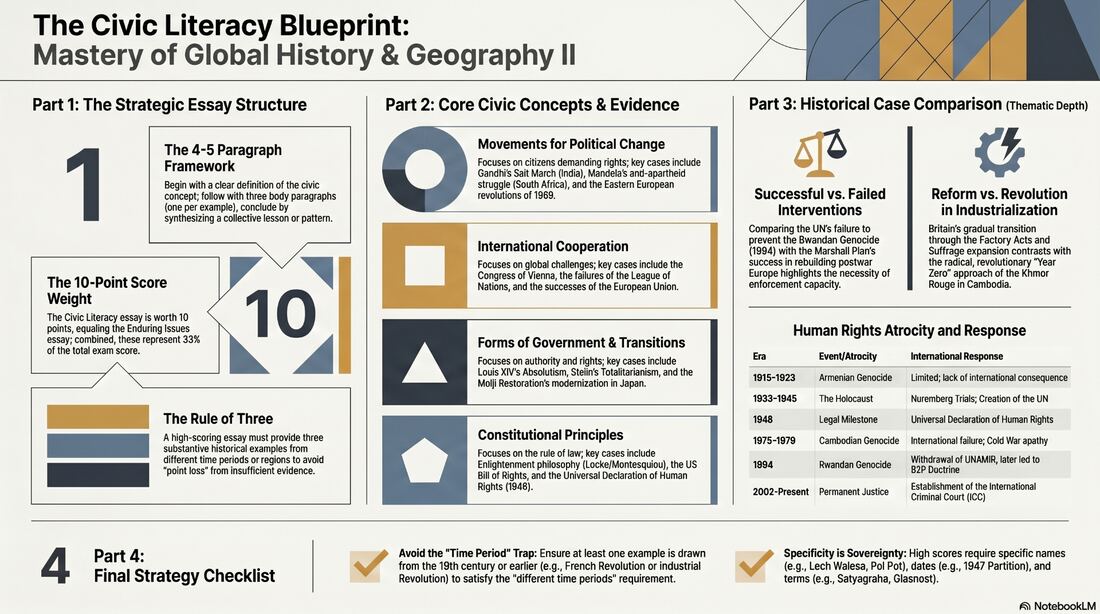
One-page diagram: essay structure, the Big 6 concepts, and the case comparisons that score.
Start the walkthroughStep 1 · Essay scaffold
The Rule of Three, scoring weight by section, and the Big 6 cases to lean on.
Read sample #1Annotated 5/5 essayA tutor that knows the NYSED framework cold. Practice MCs, grade essays, or just ask why.
Ask first questionOpens the chatEach card opens the outline plus every resource tied to that era.
Belief systems, the Asian-centered world, absolutism, mercantilism, and the Atlantic trade — the baseline for everything that follows.
Scientific Revolution → Enlightenment → American, French, Haitian, and Latin American revolutions → Napoleon → Italian & German unification.
Why Britain first, key inventions, factory life, new classes, capitalism vs. socialism vs. communism, reform movements, and the global spread including Meiji Japan.
Motives of the New Imperialism, the Scramble for Africa, British India and the Sepoy Mutiny, China's Century of Humiliation, and resistance movements worldwide.
WWI (MAIN causes, Sarajevo, Versailles) → Russian Revolution → interwar totalitarianism (Mussolini, Hitler, Stalin) → WWII → the Holocaust → the atomic bombs.
Yalta/Potsdam, Iron Curtain, containment, Chinese Revolution, Korea, Cuban Missile Crisis, Vietnam, proxy wars, Gorbachev, and the fall of the USSR.
End of European empires: Gandhi and Indian independence/partition, founding of Israel and Arab–Israeli wars, African decolonization, apartheid and Mandela, the Iranian Revolution, and the Non-Aligned Movement.
Modernization vs. tradition: the Iranian Revolution (Shah's White Revolution, Khomeini, Islamic Republic), Atatürk's Turkey, Mao/Deng China, Hindu nationalism, Saudi Arabia, and global religious fundamentalism.
Post-Cold War integration: WTO/NAFTA/EU, the rise of China, the internet and smartphones, climate change (Kyoto/Paris), migration, 9/11, the 2008 crisis, COVID-19, populism, and Russia's invasion of Ukraine.
Capstone unit: the 1948 Genocide Convention's strict legal definition, the four canonical genocides (Armenian, Holocaust, Cambodian, Rwandan), Bosnia/Srebrenica, and contemporary cases — Darfur, Rohingya, Uyghurs, Syria — plus the international response trajectory from Nuremberg → UDHR → ICTY/ICTR → ICC → R2P.
A tutor that knows the NYSED framework cold. From the Treaty of Versailles to the Iranian Revolution — explained at honors level.
Stimulus-based MC, paired-document CRQs, and full Enduring Issues Essay prompts — generated in the actual Regents format.
Paste your draft and get a score on the official NYSED 0–5 rubric, plus the two or three edits that move you up a band.